Sound Reflection & Absorption Calculator
Optimize your room acoustics by calculating reflection and absorption coefficients for walls, ceilings, and floors. Improve sound clarity, reduce echo, and balance reverberation for PA systems, home theaters, or studios.
Acoustic Results
60 units
140 units
1.2 s
What Is a Sound Reflection & Absorption Calculator?
A sound reflection and absorption calculator estimates how much sound energy is absorbed or reflected by a surface. It uses surface area and acoustic coefficients to calculate absorbed energy, reflected energy, and approximate reverberation time (RT60). This helps optimize room acoustics for home theaters, PA systems, studios, and listening rooms.
How to calculate sound absorption coefficient
- Measure surface areas of walls, floor, and ceiling in square feet or meters.
- Enter the absorption and reflection coefficients (0 = fully absorb, 1 = fully reflect).
- The tool calculates absorbed and reflected sound energy and estimates room reverberation time.
- Use the results to plan placement of acoustic panels, bass traps, and diffusers.
- Adjust reflection/absorption to balance clarity, SPL, and echo reduction.
Formulas & Acoustic Notes
- Absorbed Energy:
E_abs = Surface Area × Absorption Coefficient - Reflected Energy:
E_refl = Surface Area × Reflection Coefficient - Reverberation Time (approx):
RT60 = 0.049 × Room Volume / Total Absorption - High reflection surfaces increase echo; high absorption surfaces reduce standing waves.
- Use proper acoustic panels, bass traps, and diffusers for controlled reflections.
- Balance absorption and reflection to avoid dead or overly “dead” rooms.
How This Acoustic Calculator Works
The tool multiplies surface area by absorption and reflection coefficients to determine energy interaction. It applies a simplified Sabine reverberation model to estimate decay time. Results help users balance acoustic treatment and minimize echo, flutter reflections, and excessive reverberation.
RT60 vs Total Absorption – Practical Examples
How Total Absorption Affects Reverberation Time (RT60)
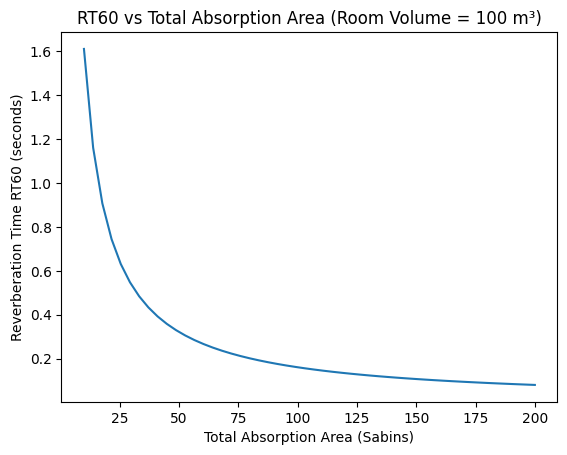
The chart below shows how increasing total absorption area reduces reverberation time based on the Sabine formula (RT60 = 0.161 × Volume / Absorption). Room volume is fixed at 100 m³.
Example 1: Home Theater Room
- Room Volume: 100 m³
- Total Absorption Area: 40 Sabins
- Calculated RT60: 0.40 seconds
An RT60 of 0.40 seconds falls within the recommended 0.3–0.6 second range for home theaters. This provides clear dialogue, controlled reflections, and balanced sound decay without creating an acoustically dead environment.
Example 2: Untreated Living Room
- Room Volume: 100 m³
- Total Absorption Area: 15 Sabins
- Calculated RT60: 1.07 seconds
An RT60 above 1 second typically produces noticeable echo and reduced speech intelligibility. Increasing absorptive surface area using acoustic panels, mineral wool absorbers, carpet, or heavy curtains reduces reflected sound energy and shortens reverberation time.
Who Can Use
- Home theater enthusiasts and audiophiles optimizing room clarity.
- Sound engineers, acousticians, and PA system designers.
- Recording studio designers calibrating room treatment and subwoofer placement.
- Event organizers and DJs managing echo and sound distribution.
- Musicians and rehearsal spaces requiring clear low and mid-frequency response.
Where to Use
- Home theaters, living rooms, and media rooms to improve audio clarity.
- Recording studios and control rooms for accurate monitoring and mixing.
- Live venues, clubs, and concert halls for PA optimization.
- Rehearsal spaces for even sound coverage and reduced standing waves.
- Any room where echo reduction and sound clarity are critical.
Core Acoustic Parameters Explained
Surface Area
Surface area determines how much sound interacts with a wall, ceiling, or floor. Larger areas increase total absorption or reflection proportionally. Accurate measurement improves reverberation time prediction and acoustic treatment planning.
Absorption Coefficient (0–1)
The absorption coefficient represents the fraction of sound energy absorbed by a material. A value of 0 means total reflection. A value of 1 means total absorption. Soft materials like acoustic foam typically have higher absorption values.
Reflection Coefficient (0–1)
The reflection coefficient indicates how much sound energy bounces off a surface. Hard surfaces such as concrete, glass, and tile typically have high reflection coefficients, increasing echo and reverberation time.
Reverberation Time (RT60)
RT60 measures the time required for sound to decay by 60 decibels. It is influenced by room volume and total absorption. Lower RT60 improves speech clarity. Higher RT60 creates a more live acoustic environment.